
Super 8 is a College initiative that sets eight simple health targets to prevent non-communicable diseases — diabetes, high blood pressure, heart disease, stroke, chronic kidney disease and cancer. In 2012 the College prepared guidelines to help workplaces, schools, cafeterias and health managers adopt the targets, and later Councils continued the initiative.
The eight health targets
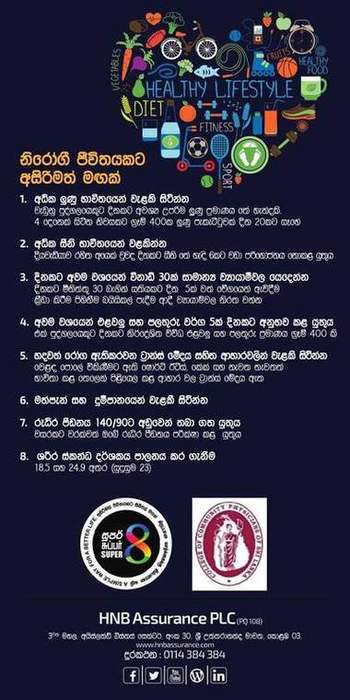
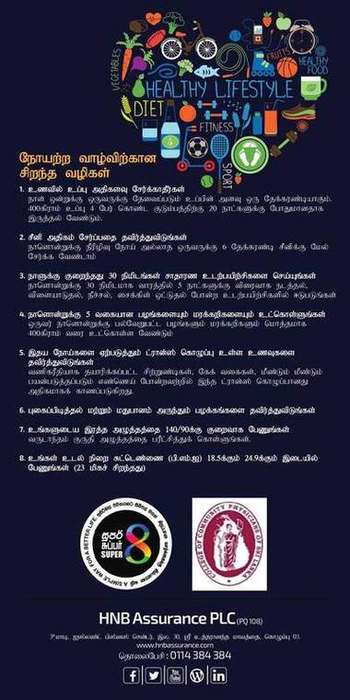
- Avoid too much salt. An adult needs no more than one teaspoon of salt a day — a 400 g packet of salt should last a family of four for 20 days.
- Avoid too much sugar. Even without diabetes, take no more than six teaspoons of sugar a day.
- Exercise for at least 30 minutes a day. At least 30 minutes on five days a week — brisk walking, sports, swimming or cycling.
- Eat at least five kinds of fruit and vegetables every day. About 400 g of a variety of fruit and vegetables a day.
- Avoid foods with trans fats, which cause heart disease. Trans fats are found in commercially made short eats and cakes, and in food fried in oil that is used again and again.
- Avoid alcohol and smoking.
- Keep your blood pressure below 140/90. Have it checked at least once a year.
- Keep your body mass index (BMI) between 18.5 and 24.9 — 23 is ideal.
Leaflets
The eight targets in Sinhala and Tamil, in a leaflet produced with HNB Assurance PLC. Click a picture to enlarge it.
Download the full leaflet (PDF): සිංහල · தமிழ்
Putting Super 8 into practice
Guidelines prepared by the College in 2012 for those introducing Super 8 in institutions and communities.
| Guideline | For | |
|---|---|---|
| A. Guideline for institutionalising Super 8 Steps from initial advocacy with senior management to training, choosing the departments to change, monitoring and review. | Lead agencies introducing Super 8 to government, private and NGO institutions | |
| B. Checklist for heads of institutions Questions to mainstream the Super 8 targets — staff awareness, screening of new recruits, menus, tea without sugar, serving sizes and more. | Heads of institutions | |
| C. Guidelines for provincial and district health managers Creating demand in communities, advocating with restaurants, hotels, local authorities and school canteens, and divisional plans by each MOH. | Provincial and district health managers and MOOHs | |
| D. Guidelines for schools Creating “Super 8 promoting schools” through principals, teacher and student focal points, school societies, posters, healthy canteens and parents. | MOOHs, community physicians and school principals | |
| E. Guide for a healthy cafeteria Informing customers and offering healthier options — no added salt in rice, sensible serving sizes, beverages with sugar served separately. | Canteen and cafeteria managers | |
| F. Quick guide for healthier menu planning Healthier snacks, beverages and meals for business and official meetings and functions, using local ingredients. | Organisers of meetings and functions, and caterers |